10 key tips for choosing a metal base and legs for your table
Choosing a metal base and legs for your table may seem simple at first glance, as there are many shapes and sizes available. In practice, however, a good choice means much more than just appearance. The base affects stability, usability, seating comfort, durability, floor protection, compatibility with the tabletop, and also how easily you can move, service or renovate the table later. If the base is too weak, incorrectly dimensioned or poorly protected, problems will quickly become apparent, such as wobbling, scratches on the floor, twisting, rust, poor fit to the tabletop or even the risk of tipping over.
Below are 10 key tips to help you choose the right design for your space, purpose, and style. The tips are written so that you can use them when choosing ready-made legs or when ordering a custom metal product, where the dimensions, materials, and details are adjusted to your wishes.
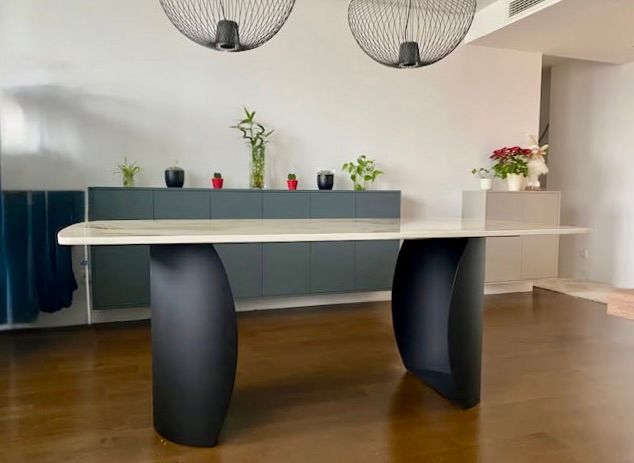
1. First, determine the purpose of the table and the real load
The most common mistake is to choose a base based on a photo or a trend, without considering what the table will actually endure. The difference between a dining table, a desk, a workshop workbench, a coffee table or a massive conference table is enormous. The base must cover two types of loads, static and dynamic. Static is the weight of the tabletop and the objects on it. Dynamic is everything that happens during use, leaning, pushing, moving the chair, children leaning on the edge, or the awkward movement when someone sits on the edge of the table.
- For a dining table, stability when leaning and resistance to lateral swaying are key.
- For a desk, rigidity and the ability to prevent the desk from rocking while typing are important.
- For a workbench, in addition to rigidity, the thickness of the material and the quality of the welds are important because impacts and point loads are more common.
- For a table with a solid oak, walnut or stone top, load-bearing capacity and a sufficiently wide standing surface to distribute the weight are important.
A practical approach is to write down the approximate weight of the board and estimate how much additional weight the table can support at one time. Then allow for a margin, as habits change over time. It is better to choose a more robust base than to solve the wobbling later with improvised shims.
2. Correctly match the base dimensions to the panel dimensions
The relationship between the size of the tabletop and the arrangement of the legs is the foundation of stability. The base must be wide enough and “open” enough to prevent tipping and to prevent the table from becoming sensitive to lateral forces. If the base is too small, the center of gravity quickly approaches the edge of the supporting surface, which manifests itself as wobble or tipping, especially with longer tables. If the base is too large, comfort may suffer, the legs may hit the crossbar, or the base may visually dominate.
- With dining tables, it is important that the legs or frame do not interfere with the chairs and knees. If the crossbar is too low or too wide, sitting will be impaired.
- For longer panels, it often makes sense to use two bases and a connecting bracket, or a central base with a sufficiently large standing surface.
- For narrow tables, such as console tables, the depth of the legs and the ability to anchor them to the wall are key if the use is intensive.
A good rule of thumb is that the leg spacing should be large enough to give the feeling of “sitting on the floor”, but not so much as to obstruct chairs or aisles. When ordering custom-made, it is helpful to provide t